7/11/2009

The new endeavor.

7/09/2009

The links and the bullets.

*God, when was the last time I did a post like this?

*Addendum Dept: I should have got this on my own, I really should have, but... well, here's the good Dr. Geoff Klock on the not-very-secret basis of Kyle Baker's "we flap" narration in yesterday's Wednesday Comics #1. Yep:


On the plus side, I'm now all the more convinced Baker is going somewhere less-than-straightforward with his serial, even if it might be toward basically the same joke as Special Forces. Or the whole thing might vanish next issue. More readers to enjoy it in a DC issue #1 anyway! Hawkman!

Geoff's whole post is worth reading, btw; it's one of the only middling-to-negative reviews of the comic I've seen set down in a formal manner, though I think it eloquently captures a lot of qualms I've seen scattered around on message boards and the like. I'm probably more inclined toward leeway, given that it's only issue #1 right now, but Geoff does leave the possibility of rapid evolution open too. Plus: thoughts on the gentle breeze of dissatisfaction drifting through Batman and Robin thus far. Go on.

*Hmm, you should probably just presume none of my links are safe for work from here downward.

*Home Video Dept: I've seen this in a few places, not the least of which was before the internet presence of Chris Mautner, but in case you haven't heard: Kino is publishing a R1 dvd compilation of Osamu Tezuka's short animations, The Astonishing Work of Tezuka Osamu, for a July 28 release. It's 13 works, 1962-88, some of which weren't actually directed by Tezuka -- Tales of the Street Corner, for example, was helmed by Eiichi Yamamoto, soon-to-be Star Blazers writer and Tezuka's co-director on Cleopatra: Queen of Sex -- but nonetheless remained redolent with the man's vision. A bonus 1986 interview with Tezuka will be included.


Granted, you've probably seen most of this stuff online -- iTunes has stocked Tezuka stuff for months now -- but I'm not objecting to a nice, easy home video collection. Legend of the Forest in particular is a grabber, an eco-fable that traces the history of world animation through its shifting visual style (with key animation by Madhouse mainstay Yoshiaki Kawajiri, among others).

Now if only we could get some Mushi Pro features around here...

Labels:

7/08/2009

The superhero comic.

Wednesday Comics #1 (of 12)

Oh, I bet you've heard of this one. It's just about Thursday right now, so I suspect a good 50% of the comics internet has already weighed in, and you might be feeling some fatigue. I'm personally tempted to just pack it in early and declare the thing an unqualified success based entirely on the strength of the Sgt. Rock page, whereupon Joe Kubert draws nine giant panels depicting: (1) Sgt. Rock being punched in the face; (2) Sgt. Rock, having recently been punched in the face; or (3) Nazis leering at Sgt. Rock's face, punched.

It's absolutely wonderful, exactly what I bought this thing hoping to see, and it probably should have been in Kramers Ergot 7 as a standalone piece. The hell with serials.


And I'm sure that's not the last Kramers mention you'll hear in reference to this comic, DC's new weekly series; it's a 16-page color newspaper, folding out to devote most of its space to one-page, 14" x 20" chapters of 15 continuing superhero stories. It's the brainchild of editor Mark Chiarello, the art-inclined mastermind of prior DC anthologies Batman: Black & White and Solo (and, lest we forget, the very first Hellboy colorist); some folks have even been calling it Chiarellos Ergot, given its generous dimensions and the varied, lavish visual approaches of its contributors.

But that line of comparison obscures one of the special pleasures of Wednesday Comics, I think. This comic might be $3.99, but it's disposable. Delicate, even! Maybe I just wasn't paying attention, but I hadn't realized this thing was a newspaper-newspaper: no cover stock, no staples, just a pulpy stack of folded-over comics, like Paper Rodeo. Leave this little number by the wrong window long enough and it's actually gonna toast; shit, my copy looks worse for wear after nothing more than scanning in a few images. I wasn't around or anything when the Diamond box opened this morning at my local retailer, but I imagine speculators burst in early to rush their take to the acid-free snugs like EMT personnel spiriting an inattentive bicyclist down to the emergency room.

That's great, isn't it? Not because I've got a beef with speculators or whatnot -- shoot, eBay to your heart's content, be my guest -- but for being such a very fine extension of one of my favorite aspects of DC's first contemporary stab at a weekly series, 52.

That project had its share of problems, definitely, but it always seemed primarily functional as a pamphlet. Not a chapter of a book (though it told long stories), or a free-floating continuity locus (despite its function as a back story gap-filler), but a weekly comic, best suited to consume quickly, every single week. It was like something charmingly out of time for DC, paced to allow the reader to ponder its storylines for a few days only; even its haphazard visual approach seemed to mark it as fast-eatin' funnybook stuff.


Wednesday Comics takes this same feel and applies it to a look-at-this candied drawing spectacular, printing all those pretty pictures on big flimsy pages.

I was briefly reminded of another famous DC-published pamphlet, Promethea #32, in which that lovely, ad-free story urged you, the reader, to physically destroy it, to literally pull the comic apart and glue it together again to form a new, different, equally readable version of the tale it told. And pamphlets are endangered things, we realize, and they keep getting brighter and prettier, more like design objects, all-considered, super-specialized - to urge the reader to do actual transformative violence to the comic's body is to demand they break free of obeying the form, and I'll be goddamned if it didn't soothe me strange. First time that 'magic' stuff worked for me.

Then the moment passed, and I relized there was a different, more obvious connotation to this thing: it's nostalgic as fuck.

It's titled "Wednesday Comics," and everything is formatted as a Sunday newspaper feature; it's romantic and longing. Don't mistake this for a PictureBox newsprint production; besides the paper quality being a little higher, there's an acute sense of self-awareness at work as to its medium. It's wistful, even a tiny bit melancholic, way down deep - it trades the old pamphlet format for the much older newspaper strip style, as if to relive the glory days of when comics were the strongest thing going, where like rainbow tints in the spray were the hues that splashed and poured from the cylinders of the New York World, like how life with like then, and then now, for now.

I presume this series is supposed to be old-fashioned yet forward-looking; indeed, even trying a format like this in today's market could be taken as an indication that the future remains open. Yet there's undeniably something to the fact that so many of these 15 debut chapters position themselves as throwbacks, ranging from Dave Gibbons' & Ryan Sook's '30s or so adventure strip spin on Kamandi to an excellent, Clowesian saga-of-multiple-strips approach to the Flash by Karl Kerschl, Brenden Fletcher, Rob Leigh and Dave McCaig.

Even as unique a stylist as Paul Pope -- colored by the always-welcome José Villarrubia -- sets his Adam Strange in a decorative Rann of smooth curves and barked educational factoids, leaning back elegantly, but pronouncedly. In here it's organic, mind you; a man in the midst of a theme, aware.


Of course, it could just be that vintage-informed art happens to exploit the format in a more pleasing way. John Arcudi's & Lee Bermejo's bronzed, painterly Superman episode is arguably old-timey in that illustrational Alex Ross way, but it runs through its superhero-on-creature fight scene plainly, with a stiff Man of Steel failing to sell the action en route to an unappealing plot setup in the final panel.

And while the 100 Bullets team of Brian Azzarello & Eduardo Risso craft a decent enough Batman opening, I can't say it looks much different from your typical page of comics from the pair, except wider on the sides and apparently trusting in the larger format to make things look better on its own. They're right, granted; only Sean Galloway seems to really suffer from the format on a generally clumsy Teen Titans page, cramming characters into indistinct time-lapse layouts and tossing them against blank or toned backgrounds as they fight. Others, like Brian Stelfreeze on a Walter Simonson-written Catwoman/Demon piece, just do their thing, in neat layouts, a little larger than usual.

Some even take the chance to pay tribute to earlier comic book periods, perhaps in the spirit of a generally nostalgic forum. I can't say much for the Metal Men page from writer/executive editor Dan DiDio -- dressing funny superhero characters up in 'wacky' '60s/'70s clothes to go out in the real world is about as cloying as these things can get, regardless of some nicely chunky art by Juan Luis García-López & Kevin Nowlan, with colorist Trish Muluihill -- although anything that moves Neil Gaiman to attempt what may be a full-blown Bob Haney homage (on Metamorpho!) can't be all bad.

That one's got art by the Madman Atomic Comics crew of Mike & Laura Allred and letterer Nate Piekos, which offers its own strange texture; somewhere along the way, and I don't know where, Madman stopped being a story evoking groovy-cool comics style drawn in a highly individualistic manner -- one that owed as much to the alt comic likes Jaime Hernandez as anyone else -- and started taking on the groovy-cool aspect merely by looking like itself. Despite its departures, it came to embody its subject matter in a way that overcame the niceties of plotting, and its that aspect it brings to the table here.


Part of the might of visuals, folks; it's something an art-focused superhero project like this can make use of, powerfully, given the expanded format. I can't help, however, but wish more of these starter pages dove deeper into their use of space, of the production values at hand.

I think it's one of the more divisive pieces, from peering around online, but I found Ben Caldwell's Wonder Woman page to be a little closer to what I could have fallen harder for in a project like this (barring further Sgt. Rock punchout parties, which could a new anthology by itself), a sort of neon-drenched anime smash-up of the dead basic Wonder Woman concept and a Winsor McCay dream strip. It doesn't work perfectly, no -- Caldwell's layout expands and contracts from big panels to clusters of tiny ones, leaving some of the action confusing while stuffing in exposition where it can fit -- but it effectively transforms Wonder Woman into something that seems native to this newspaper, something a little retrospective, if never really like Little Nemo in Slumberland, yet emphatically modern as well.

Don't let me understate the fun of this comic, though. It's a sturdy whole in spite of its faults, and its presentation has charm to burn. I'm really looking forward to seeing it around every week, and watching its stories develop. Even while some of them seem simple, others are harder to place with certainty.

Kyle Baker, for instance, brings this terrific, befuddling Hawkman page, starting off with a huge, distorted close-up of a bald eagle, apparently narrating the story. Hawkmen can communicate with birds, you know, and the bald eagle sings his praises as an improbably diverse flock joins him dangerously in the sky.

"We flap," the bald eagle intones, not for the last time, as Hawkman bursts into action right toward the reader in a massive center image, sword drawn and mace swinging. The narration builds in portent as the legion approaches an airplane, the pilots with guns to their heads. The birds flap onward.

"Our master knows his place in the universe. He is a leader."

And the next issue slot screams BATTLE AGAINST TERROR!


Shit, this sounds pretty wry. And big, loud and muscular! The latter's my first impression, and the former will need space; its tone will be serialized. It's the last thing in this issue, and as good a grace note as any.

Labels:

7/07/2009

The print repost.

Herbie Archives Vol. 1 (of 3)

(first published in The Comics Journal #295, Jan. 2009; the formatting and some wording differs, as do the pictures)


This is another one of those pricey ($49.95) Dark Horse Archives collections, which I haven't really kept up on; shrink wrap does that to the compulsive flipper. I do, however, recall the restoration quality varying a bit from project to project, particularly in terms of color - some of the books employed flat, solid tones obviously meant to approximate vintage colors via digital means but often laid too opaque for my tastes, leaving the line art overwhelmed.

I'm happy to report that this one's different; the digital restoration, credited to Aren Kittilsen, preserves the aspect of inexactness present in all those evident dots from the '50s and '60s, albeit likely made slightly more respectful of line borders, and definitely left whiter (sometimes slightly bleached) from the cleanup. I'm no restoration expert, but it strikes me as a good effort, given the comics involved.


(dots aren't crazy for scanners like mine, though)

After all, the foundational visual appeal of those works is Ogden Whitney's juxtaposition of chilly commercial draftsmanship with jarring instances of disrupted reality; when a dog lifts his paw up to point a human-looking thumb backward -- as typical a cartoon gesture as can be -- it's funny because it's genuinely a freakish thing to see in Whitney's square world. The uncertainty of period coloring processes only underscores this feeling, giving all those suited men and their hats an extra old-timey boredom while latently suggesting a universe prone to coming apart at the seams whenever a fat kid should suck on the right lollipop and walk off into the air, plain as day.


Anyway, this book collects the first five issues of the American Comics Group's 1964-67 Herbie series, plus 75 or so pages of earlier shorts (1958-63) from Forbidden Worlds, along with a miscellaneous Unknown Worlds story in which the character appears briefly. It's stuff you've probably seen fêted for years, and it's good that there's a big new collection out, but be aware that it's still a mostly repetitive kids' comic -- being the adventures of the corpulent title lad, hated at home yet actually an unlikely powerhouse adventurer -- in spite of writer/editor Richard E. Hughes' likeably nastier-than-usual sense of humor (Herbie on your not buying the next issue: "Only means blood, fractures, teeth scattered around. Not nice.") and Whitney's askew visual constructions.

Still, it's fine in small, period-appropriate doses, and armed with an accomodating page presentation, less lolly-solid than cinnamon-spread.

Labels:

7/06/2009

The weekly feature.

*Hmm... two reviews last week, both of them focused on artists that absorb characters into their backing environments. Didn't plan that at all.

LAST WEEK'S REVIEWS:

Children of the Sea Vol. 1 (the North American debut of Daisuke Igarashi in a book all his own; atmospheric fantasy like a child's daydream on a humid afternoon)

Plus!

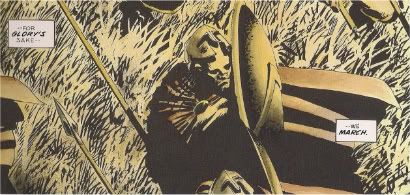
Conquering Armies (a heavy realist, Heavy Metal classic from 1978, in which Jean-Pierre Dionnet & Jean-Claude Gal lay waste to heroic accomplishment by way of sheer, cruel scope)

At The Savage Critics!

*What I did plan, however -- and the plan's still on -- was to do 10 posts in 10 day, one after another, each one taking on an interest/recurring feature of mine. I haven't done any daily blogging in a long while either, and I'm eager to see if I can keep it up. Might even get some stalled projects running - who knows?

THIS WEEK IN COMICS!

Asterios Polyp: If you're going to be listening to talk about comics in the second half of 2009, you'd better prepare to hear about this, off and on, over and over; the superlatives are getting thrown. Being the grand return of David Mazzucchelli to comics, a $29.95, 344-page Pantheon hardcover tracking the escape of the titular architect & teacher from the present strictures of his life when a bolt of lightning destroys his apartment, all while the past hovers and interjects, and style commands all perception, self-evidently, from the progress of time to the cadence of speech. Moreso than usual, I mean. Aw, just check it out when you see it, and you will see it.

Everybody is Stupid Except for Me and Other Astute Observations: Peter Bagge, in contrast, hasn't been gone for nearly so long, but it's still good to see a new book. This one's a 120-page Fantagraphics softcover, collecting 10 years' worth of comics-format op ed stories for Reason, archived online here. It's $16.99. Preview here; slideshow and wallpaper here.

Wednesday Comics #1 (of 12): The front-of-Previews item of the week, for sure. And it's pretty special even setting aside the specifics of the format: a weekly, folded-over 14" x 20" color pamphlet, 16 pages for $3.99 featuring 15 one-page serials, evoking post-WWII Belgian comics magazines (some of those features never got collected!) as much as the Sunday funnies of yore. No, I'm taken by something simpler - DC is launching its new every-week comic slot on the might of art, of visuals, which is a considerable swing of the pendulum away from 52, a subtext of which inadvertently turned out to be "visual flair doesn't matter, get it out, it's fine." Like, I agree with the notion that one of the charms of the series was witnessing the writing staff bump their individual styles against one another, but it's noteworthy that the artists didn't get the chance to build anything like that, filling out Keith Giffen's breakdowns in a sometimes strained manner, clashing with no logic. Trinity went a ways toward changing that, but now - you're surrounded by drawing.

And in this place, that's something. Features: Kyle Baker, Paul Pope, Ben Kaldwell, Adam Kubert & Joe Kubert, Neil Gaiman & Mike Allred, John Arcudi & Lee Bermejo, Dave Gibbons & Ryan Sook, Jimmy Palmiotti & Amanda Conner, Walter Simonson & Brian Stelfreeze, Kurt Busiek & Joe Quiñones, and many more.

100 Bullets Vol. 13 (of 13): Wilt: And if one page isn't enough, here's the final $19.99 softcover collection of a much bigger work by the Wednesday Comics Batman team of Brian Azzarello & Eduardo Risso. Collect 'em all.

Superman: Whatever Happened to the Man of Tomorrow?: Oh no, Watchmen is coming out on dvd in two weeks! What's a publisher to do?! Ah ha - how about a spanking new $24.99 hardcover collection for writer Alan Moore's various beloved super-stories? Note that Action Comics Annual #11 (For the Man Who Has Everything) and DC Comics Presents #85 (a Swamp Thing encounter) are in here too, although the title saga is obviously the main draw.

I've always found that story's renown as a three-hankie pre-Crisis Superman farewell to be a little odd; to me, it's among Moore's most distanced superhero studies, pluck pluck plucking at old school Superman tropes with the steadied hands of a researcher manipulating volatile materials. Surely the era-ending catastrophe Superman faces is mainly the result of undue logic applied to those story elements -- Bizarro seeing mass murder as the inverse of a vow against killing, villains just blowing Clark Kent's clothes off on the air, a capricious imp simply deciding to be maleviolent rather than silly -- causing the action to tumble forward with all the inevitability of a mathematical formula scratching across the chalkboard.

Granted, it's been suggested that this is part of the point, that applying the slightest feather's weight of a skeptic's logic to Silver Aged ideas sends the whole world crashing into bedlam, and ain't it a shame, but - that seems awfully simplistic, particular compared to some of Moore's other superhero works. Casting Superman's classic, non-killing ideals as unable to sustain a Super-world in the face of big '80s thinking seems less like insight than spiting the present by walling off the past, and if it's all just supposed to be a simple appreciation of The Way We Used to Be, it's very much a fond gaze cast through a museum's glass, before moving on to the business of the active, present superhero world.

Then again, Moore didn't really have a choice on the whole 'walling off the past' thing, but hey - an experiment is always affected by the conditions under which it's conducted! Helpful souls they are, DC is also offering issue #1 of All Star Superman this week as a $1.00 special, for further reading. Plus: Tom Strong #1, also for $1.00, should you elect further Moore.

Marvel Masterworks: Warlock Vol. 2: But then, there are earlier sagas to pursue. My sitemate Douglas Wolk went deep into this formative '70s cosmic superhero material in Comic Art #8 (and later his book, Reading Comics), but for our purposes here I'll only mention that it's safe to ignore the "vol. 2" in the title, since this tome starts right up with the arrival of Jim Starlin in 1975's Strange Tales #178 and follows his form-flexing revival of the Adam Warlock character through the resumed Warlock series and into the deathly double coda of Avengers Annual #7 and Marvel Two-in-One Annual #2. Plus: a bonus Spider-Man/Warlock story by Bill Mantlo & John Byrne from 1977's Marvel Team-Up #55. Restless, determined philosophical space pulp, as you like it. It's $59.99 for the whole deal in hardcover.

Prince Valiant Vol. 1: 1937-1938: Or shit, go way back. This is a newly restored Fantagraphics series, presenting the Hal Foster classic in 10.5" x 14.25" hardcovers. This debut fills 120 color pages, supplemented by a vintage Foster interview from The Comics Journal. It's $29.99; samples here.

RASL Collector's Edition Vol. 1: And in other hardcover repackaging news, if that big softcover collection of the first three issues of Jeff Smith's ongoing sci-fi thing wasn't good enough, how about a $50.00 edition with Smith's signature and 16 bonus pages of sketches and script? Limited to 3000 copies. Note that Smith's Cartoon Books also has its 13th printing of the all-in-one $39.99 Bone brick this week. Ha ha, the 13th printing is the unlucky one; I bet it takes several additional months to sell out!

The Nobody: A new Vertigo original hardcover, 144 b&w pages for $19.99, in which Jeff Lemire (of the much-acclaimed Essex County stories from Top Shelf) transposes elements of H.G. Wells' The Invisible Man to a sleepy fishing village, raising all the expected 'small town' concerns in the process -- paranoia, prejudice, teen alienation, outcasts, symbolic butterflies, etc. -- in pretty much exactly the manner you'd expect. Still, Lemire's got a firm point of view, a visual sensitivity that brings out a human softness and bucolic prickle lacking in other such high Vertigo stories-from-old-stories, and it may well gaze deeper next time; I'll post a link to my full review once it's available for online access. Preview; video.

B.P.R.D. 1947 #1 (of 5): The second new Mignolaverse series in as many weeks, although this one's set as a sequel to last year's pretty great B.P.R.D.: 1946, starring Prof. Trevor Bruttenholm, 'father' of Hellboy, as he inspects the occult aftermath of the Nazi reign. Co-writer Joshua Dysart returns, now with artists Gabriel Bá & Fábio Moon, which should prove interesting. Looks juicy from here.

Pixu: The Mark of Evil: More Moon & Bá! More more more!! Okay, Dark Horse also has this hardcover collection of their two-volume, self-published urban complex horror tale created with Becky Cloonan & Vasilis Lolos. With bonus sketchbook content; $17.95. Preview.

World War Robot Vol. 2: Another 48 oversized (12" x 12") pages of color canister conflict from artist Ashley Wood. As always, IDW publishes; $11.99.

From the Ashes #2 (of 6): Woah, Peter Bagge and Bob Fingerman in one week! All we need now is a new issue of Cud... anyway, this is Fingerman's IDW series about the little concerns of the post-apocalypse situation. Peer.

I Am Legion #4 (of 6): DDP/Humanoids, continuing.

The Zombies That Ate the World #4 (of 8): Ditto.

No Hero #6 (of 7): More superhero mutation from Warren Ellis & Juan Jose Ryp. Last issue was fun, although begging comparison to The Boys didn't work in its favor; the series' agony comes off best when it's tactile, not social. Approaching the endgame should offer some focus. Also, if your store didn't get the new Crossed last week (mine didn't, so I'm guessing Diamond missed the east coast), expect that too.

Elephantmen: War Toys: Yvette: It's not like most issues of Elephantmen aren't already displaced vignettes from a teeming world edging slightly through time -- or that the current 'storyline' isn't a suite of one-offs dealing with otherwise periphery characters, to the extent that anyone in this series has primacy for long -- but since we're bouncing way back in time to focus on a character that died in the War Toys miniseries, this is a special issue rather than just the next issue, although it's basically that too. All-combat action from the days when giant talking animals fired guns and swiped swords at China's military across the disease-ridden ruins of Europe, in color this time, pencilled by returning series artist Moritat; preview here.

Neon Genesis Evangelion: Shinji Ikari Raising Project Vol. 1: Ah, good ol' Eva, the gift that keeps on giving to publishers that happen to have a hand on the license when the franchise rustles itself into activity yet again. This manga, however, has nothing to do with the new Rebuild of Evangelion series of anime movies -- Neon Genesis Evangelion: 1.0 You Are (Not) Alone is floating around North American events now, while Neon Genesis Evangelion: 2.0 You Can (Not) Advance just opened in Japanese theaters a week and a half ago, and a concluding double-feature finale is still forthcoming -- although I'm sure the release timing is no coincidence.

No, this is an ongoing Osamu Takahashi series started in 2005, currently up to vol. 8 in Japan, based on the 2004 'life simulation' PC game (a la Princess Maker) in which you the player raise Eva's titular boy non-hero into something hopefully worthwhile, all in the confines of an alternate universe set up in the notorious final episode of the original 1995-96 television anime series, in which a new life for Shinji was glimpsed as the star of -- ha ha -- a totally different anime formula series, the high school love comedy. But wait, you say, wasn't there already a manga based on that half-minute glimpse into a new universe? Close! You're thinking of the 2003-06 manga series Neon Genesis Evangelion: Angelic Days, which was actually an offshoot of a different video game set in that secondary world, the 2005 'visual novel' Neon Genesis Evangelion: Iron Maiden 2nd (aka: Neon Genesis Evangelion: Girlfriend of Steel 2nd), itself a non-sequel to the 1998 visual novel Neon Genesis Evangelion: Iron Maiden (Girlfriend of Steel), which was an in-continuity bonus story set in the main Eva universe.

So, just to get it all down in one shot, this manga is a spin-off of a computer game based on an alternate universe from the anime series which spawned an additional computer game and accordant manga series that act as an parallel universe to the alternate universe. And none of this, by the way, is to be confused with the official ongoing Eva manga adaptation, which original character designer Yoshiyuki Sadamoto has been working on since 1995. Oh, and they're all published in North America by different entities: VIZ for the official manga; ADV Manga for Angelic Days; and Dark Horse for the present volume, $9.95 for 184 pages, which you can preview here. It's probably crap.

P.S. - THESE ARE NOT THE ONLY EVA MANGA.

I dunno, maybe the all-new Rebuild ending is gonna be like Primer?

Labels: ,

7/05/2009

The old Eurocomic.

*New column up at The Savage Critics, on the topic of Jean-Pierre Dionnet's & Jean-Claude Gal's early Heavy Metal story suite Conquering Armies. I toyed with the idea of posting exactly the same material labeled as a review of Justice League: Cry for Justice #1 (of 6), and subsequently insisting the contents were exactly that, but I decided the confusion would be more trouble than the joke was worth (nothing whatsoever). Enjoy.

Labels:

7/04/2009

The mainline manga.

Children of the Sea Vol. 1


This will be out very soon from VIZ. It's a $14.99 softcover, with 320 mostly b&w pages.

It's also the first release in the publisher's new SigIkki sub-imprint, combining the preexisting VIZ Signature line of 'prestige' releases with Japanese publisher Shogakukan's Ikki Comix line of alternative-flavored contemporary manga. Ikki is also Shogakukan's monthly serializing print anthology for many of these works -- the title refers to countryside uprisings against feudal lords, which strikes me as gilding the lily a bit for a Big Three anthology -- but VIZ plans to use the brand primarily as a means of serializing 'mature' manga for free online before offering deluxe print collections at the aforementioned premium price point.

And make no mistake: this is a fairly lovely production, attuned to presenting mostly lovely visuals. Artist Daisuke Igarashi enjoys a renown among North American manga obsessives well beyond his scant official catalog in English, which, prior to this, consisted entirely of one short story in Fanfare/Ponent Mon's Japan as Viewed by 17 Creators; I strongly doubt many will find this production terribly lacking in its role as the first 'major' Igarashi release in English, even given their free access to the guts of it online.

But it's still worthwhile to note that this volume is also the most traditional adventure manga I've seen from this artist, one who isn't exactly a bleeding edge provocateur to begin with. Hell no - at heart, Igarashi's a popular fabulist of the Miyazaki style, albeit a modified variant that slashes away the antics and sentiment to isolate all those wonderous and creepy strains of mystic-bucolic mythmaking.

For example, the artist's 1994-96 story suite Hanashippanashi (and his similarly-styled Fanfare short) bombarded readers with weird visions of extra-normal creatures, so dominant as to suggest surrealism through devout force of their taximony, though the experience was always grounded as human observation of presences in a known, familiar world; Teratoid Heights it wasn't. Likewise, the 2003-05 series Witches (Majo) positioned its eruptions of ancient power as undercurrents to historical (metaphorical) contexts, with a passion for delineating pagan resistance to newer societal structures that recalls nothing so much as early (or proto-)Vertigo comics.

Children of the Sea presses this outlook into even gentler, more straightforward territory; at times it could almost pass for shōjo manga, what with a surfeit of mysterious, aestheticized pretty boys centering its story of a 'typical' girl dropped into an exciting plot wherein her marvelous secret powers are revealed. Perfectly nice, sure, but it signals a certain prudence on VIZ's part; they might be spelling comics with an x on the end, but they're making damn sure their base readership doesn't take that as a "Keep Out," which possibly goes a ways toward explaining why they're launching the imprint with an ongoing one-collection-per-year monthly series, only up to vol. 3 in Japan, from an artist whose bibliography is littered with one-or-two-book projects prime for easy release.

Still, if there's any current (to English) manga this project recalls from its particulars, it'd have to be Yuki Urushibara's Mushishi, and not only because Urushibara and Igarashi place a similar visual emphasis on detailed, enveloping backgrounds and swirling mark-made blasts of glowing phenomena; both of their stories guide wide-eyed people, often young, through a hidden aspect of the natural world, something that affects their being in a way that nonetheless can be taken as the primal, pre-societal way of things, with 'danger' present mainly as the individual's lack of due study, or simple ignorance. Heck, Igarashi even tosses in a teacher/shaman/scientist figure who's picked up a few tricks (and a lack of social grace!) on his travels.

Yet Igarashi's work aims to saturate far more than Urushibara's rather literary approach; he's a considerably stronger visualist, first and foremost, with a special talent for integrating his scratchy character designs into their surroundings and stretching moments to let his narrative eye linger on otherwise fleeting experiences, like a bug landing on your shoulder or a seagull swooping parallel to your bike.

It's not a perfect performance, no - setting aside localization concerns like the English lettering never quite blending with the artist's fine lines (and my personal editing pet peeve of inconsistent chapter title translations between the table of contents and the text proper), Igarashi's grasp of vivid, extended moments doesn't always extend to fluid character movements or nuanced 'acting,' and a few of his attempts at multi-panel lyricism of stillness simply don't work, like a bit where the story suddenly goes sideways for one splash, distractingly. But these aspects never entirely upset the wash of the artist's approach, one part plotting and three parts atmosphere, surrounding the reader with the beauty of his world, and all of its accordant mystery.

In other words, if we walk beside helpful Ginko in Urushibara's series, listening to his many episodic lectures on What This All Means, Igarashi places us in firmly in the role of the affected citizenry, wandering in amazement and concern through their own extended saga. And you can bet your ass it's kids that are affected, and adults can't entirely help, caring as they can be; so it frequently goes in those Miyazaki spectaculars!

Indeed, in spite of its T+ rating, Igarashi's plot unfolds like a fit-for-children adventure for all ages, if unusually prone to staring off into poetic space; it's even situated via prologue as a story being told by one of its now-adult participant to an eager child. Ruka is a moody, anti-social young girl whose deep hunger to fly doesn't preempt earthly concerns, like sending a classmate to the hospital after she stomps her foot on the handball court. Exiled from summertime club activities, Ruka pisses off to Tokyo for the day, where she runs into Umi ("Sea"), a curious boy with a major connection to the ocean.

Is it chance, or does it all have something to do with Ruka's own attraction to sea life, and her memory/dreams of seeing a ghost at the aquarium where her father works? Before you know it, Our Heroine is whisked away into a wish-fulfillment fantasy of living in a fun environment (said aquarium) with a far away divorced parent (said father), filled with kindly adults ready to teach her snorkeling and magical friends like Umi and his distinctly bishōnen pal Sora ("Sky"), who can't stay out of the water for too long, and know of the burning souls in the sky. All the while, rare fish school to Japan as speckled specimens vanish from captivity across the world; global shit is going down, as Igarashi indicates via to-the-reader testimony from witnesses across the world, which does admittedly jumble the subjective storytelling motif.

Try not to sweat the details, like how a major aquarium keeps supernatural young kids swimming around in the tanks and treated at local hospitals without any discernible media attention; Igarashi certainly didn't. Rather, his emphasis is on people as elements of spaces, and his children just that: children, of the natural parent, the environment, glimpsed through contorted time and countless blinking glances at place, the artist's subject and the true basis of his story. All else is finally supplicant, and from this we become like kids ourselves, seated agog at roiling waves and starscapes below sea level as summertime passes slowly. It may not be experimental, but the experiential has virtues all its own.

Labels: